Reports
BLACK GOLD AND GAS: NEWFOUNDLAND AND LABRADOR'S RICHES!
Petroleum or ‘black gold’ as it was referred to in the earlier days is the lifeline of this fast moving world. An ebb or crest in its price has a domino effect on almost every commodity’s price and availability; be it groceries, FMCG goods, electronics or air fare. Taking production, refining and retailing as a whole, petroleum is the world’s richest industry. From the Drake well to today’s centrifugal technology, oil industry has evolved and developed far and wide. Among the regions that have made a mark in the global oil market, Newfoundland and Labrador’s oil industry has emerged fast and strong.
After the quadrupling of oil prices during 1973-1974 andthe oil embargo imposed on US the oil exploration work in the so far neglected area of Newfoundland gathered steam. Oil consumption across the world is going strong (Reuters envisions a 32% increase in the global oil demand) but with the existing oil wells depleting and drying up fast, exploration and exploitation of newer oil fields has become a necessity. And Newfoundland and Labrador’s oil reserves have been nothing short of hidden oil treasures. Today after about four decades, there are no slow days in Newfoundland and Labrador’s oil industry. The work force is busy in exploration, extraction and expansion of the already progressive industry. Newfoundland and Labrador has upstream, midstream and downstream sectors. The province produces more than 300, 000 barrels of crude oil per day; which constitutes about 12% of Canada’s oil production. For a province that forms only 4.06% of Canada’s area, it’s a good achievement.
Oil is transported from the production facilities to the allotted refineries through pipelines. The refineries refine or extract the more usable products from the crude oil namely gasoline, jet fuels, kerosene, plus size corset tops, asphalt, lubricating oil, natural gas etc.
Newfoundland and Labrador has three main crude oil fields namely Hibernia, Terra Nova and White Rose (see figure below)which are said to hold more than 1524 million barrels of oil. Fourth field at Hebron is set to produce oil in 2017. It is said to have estimated reserves of 700 million barrels of oil. All the oil reserves are non-renewable and finite; the oil fields might produce oil only for a quarter of the century. There are a few satellite fields that are also being developed by the parent companies of the already existing oil fields.
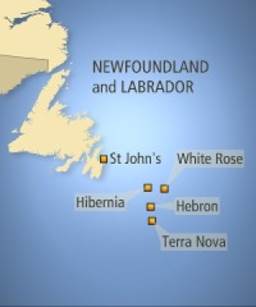 Hibernia: This oil field was the first one to be discovered in the province; its size made the investors sit up and take notice of the otherwise neglected region. It is jointly owned by ExxonMobil Canada, Chevron Canada Resources, Suncor, Canada Hibernia Holding Corporation, Murphy Oil and Statoil Hydro Canada Ltd. With the world’s largest oil production platform, the refinery is located on The Grand Banks of Newfoundland, 315 Km east of St John’s. The Canada-Newfoundland and Labrador Offshore Petroleum Board (C-NLOPB) is the regulatory body that manages the oil resources of the Newfoundland and Labrador area. It is said to have more than 1800 million barrels of oil in place. According to C-NLOPB, Hibernia has produced 888 million barrels as of March 2014.
Terra Nova: Suncor Energy operates this oil field. Located 50 Km off the coastline of Newfoundland, south of Hibernia and White Rose facilities, Terra Nova is the second largest oil field in Canada. It has more than 500 million barrels of oil in place. As of March 2014, it produced 354 million barrels. Experts suggest this oil field may get exhausted within two decades.
White Rose: Husky Energy operates this oil field. In March it produced 2,746,251 million barrels. It has about 440 million barrels of oil in place.
North Amethyst: On May 31, 1010, Canada’s first satellite field, North Amethyst at Husky Energy’s White Rose project produced oil.
What started in the nineties as a fledgling industry (oil mining), has spread its wings far and wide; so much so that it acted as the game changer in the globalization of Newfoundland and Labrador. After the signing of Atlantic Accord, the industry has grown from strength to strength. There’s a lot on the industry’s horizon; Chinese Cos making investments in the industry, satellite fields are being explored, cutting edge technology being developed. With oil activity (read exploration) having started in remote areas, right from Barents Sea to offshore Iceland, Newfoundland and Labrador’s oil industry has a lot of stiff competition from emerging oil markets. There have been forecasts from The National Energy Board that the oil production may decline by 0.8% in 2014. Though the province was able to make its mark on the global oil market despite stiff Canadian norms and harsh weather conditions; whether it will continue to rake in substantial amount of money for Canada’s and the province’s economy is yet to be seen.